Related Research
System Design
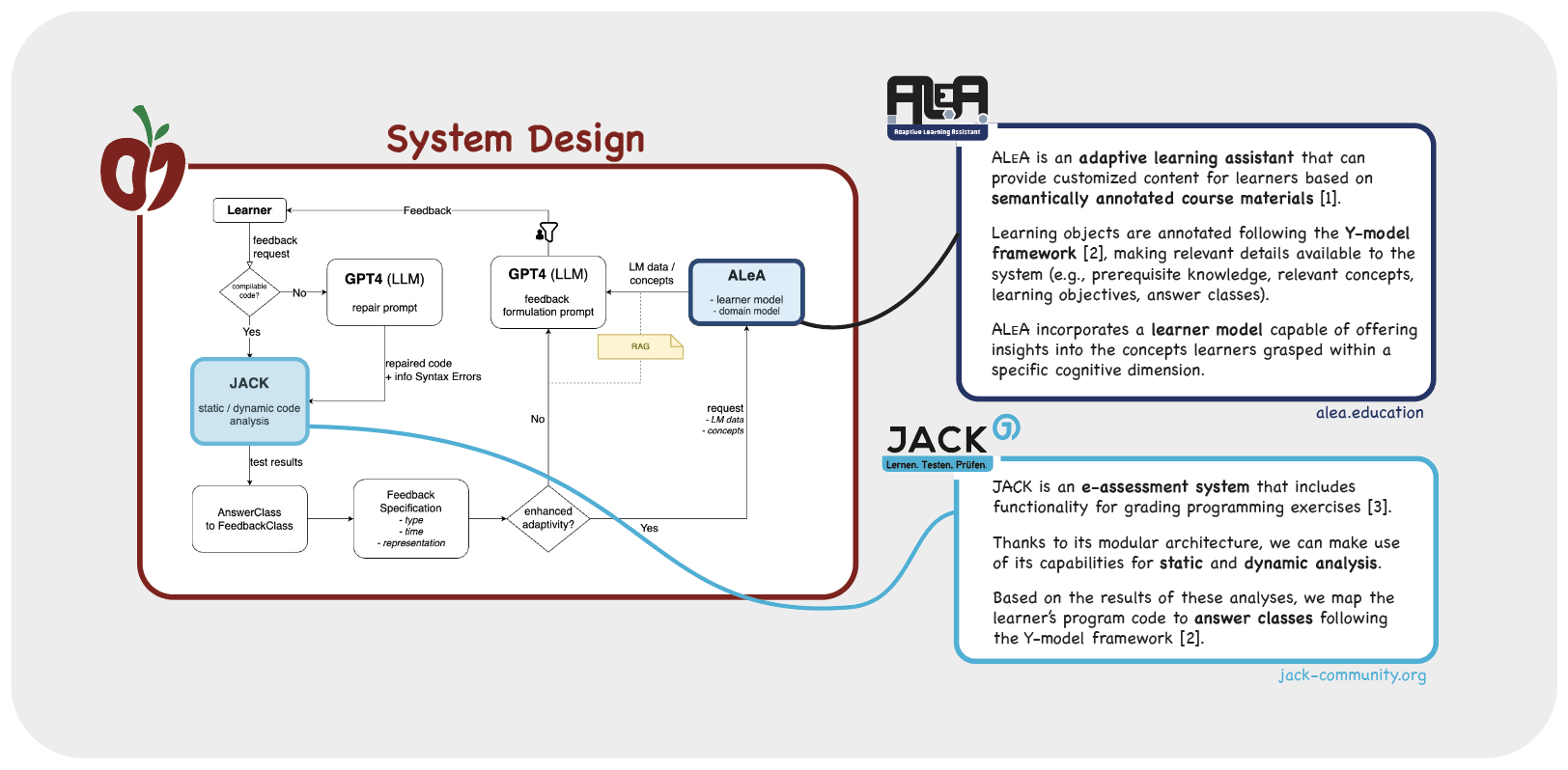
APFEL System
The APFEL system (Adaptive Programming-Feedback for E-Learning) aims to provide personalized and formative feedback to students learning programming. Below is an overview of the system design. Click on the figure to access the full poster.
Lohr D., Berges M., Chugh A., Striewe M.
Adaptive Learning Systems in Programming Education: A Prototype for Enhanced Formative Feedback
DELFI Fachtagung Bildungstechnologien 2024
year: 2024
ALeA
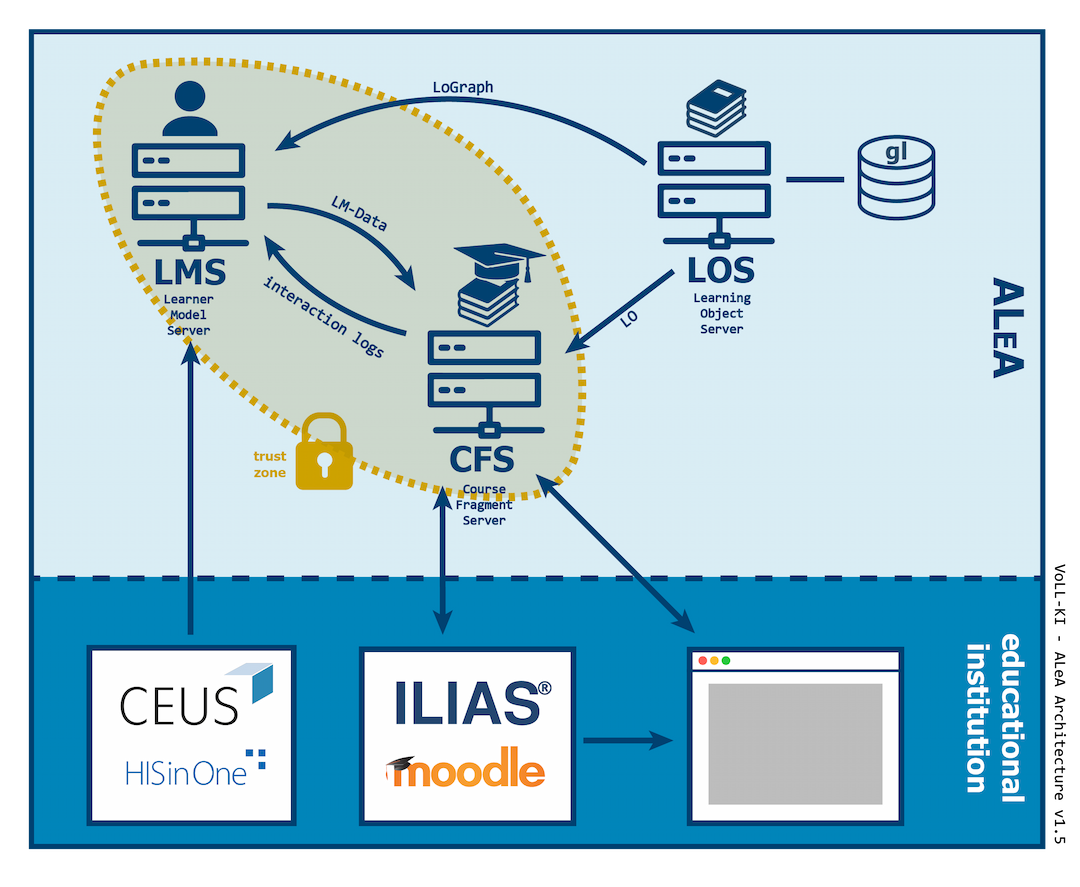
ALeA is an Adaptive Learning Assistant and a university course material platform, currently deployed for ≥ 1000 students in six computer science courses. It encompasses the components of intelligent tutoring systems (ITSs), namely a student module, an expert module and a pedagogical module as well as the user interface.
The Course Fragment Server CFS provides an ontology of abstract concepts to be learned. These concepts are shareable across courses, subjects, and universities. The Learning Object Server LOS provides course material as HTML, ranging from individual definitions, exercises, examples, or explanatory snippets, up to full lecture notes. This material is annotated with references to the ontology from the Content Object Server. A Learner Model Server LMS (corresponding to the student model of the ITS), associates learners with their estimated mastery of a given concept.
Kruse, T., Berges M., Betzendahl, J., Kohlhase M., Lohr D., Müller, D.
Learning with ALeA: Tailored experiences through annotated course material
INFORMATIK 2023. Designing Futures: Zukünfte gestalten
year: 2023
Berges M., Betzendahl, J., Chugh A., Kohlhase M., Lohr D., Müller, D.
Learning Support Systems Based on Mathematical Knowledge Management
CICM23. Intelligent Computer Mathematics
year: 2023
Feedback in Programming Education
The Educators' Perspective: How and Why Experts Provide Feedback
Lohr D., Kiesler N., Keuning H., Jeuring J.
"Let Them Try to Figure It Out First" - Reasons Why Experts (Do Not) Provide Feedback to Novice Programmers
ITiCSE 2024: Innovation and Technology in Computer Science Education
year: 2024
Jeuring J., Keuning H., Marvan S., Bouvier D., Izuu, C., Kiesler N., Lehtinen, T., Lohr D., Petersen, A., Sarsa, S.
Towards Giving Timely Formative Feedback and Hints to Novice Programmers
ITiCSE 2022: Innovation and Technology in Computer Science Education
year: 2022
The Learners' Perspective: What students consider valuable feedback
Formalization of Computer Science Tasks
Answer Classes
Lohr D., Berges M., Kohlhase M., Rabe, F.
The Potential of Answer Classes in Large-scale Written Computer-Science Exams
Hochschuldidaktik Informatik (HDI23)
year: 2023
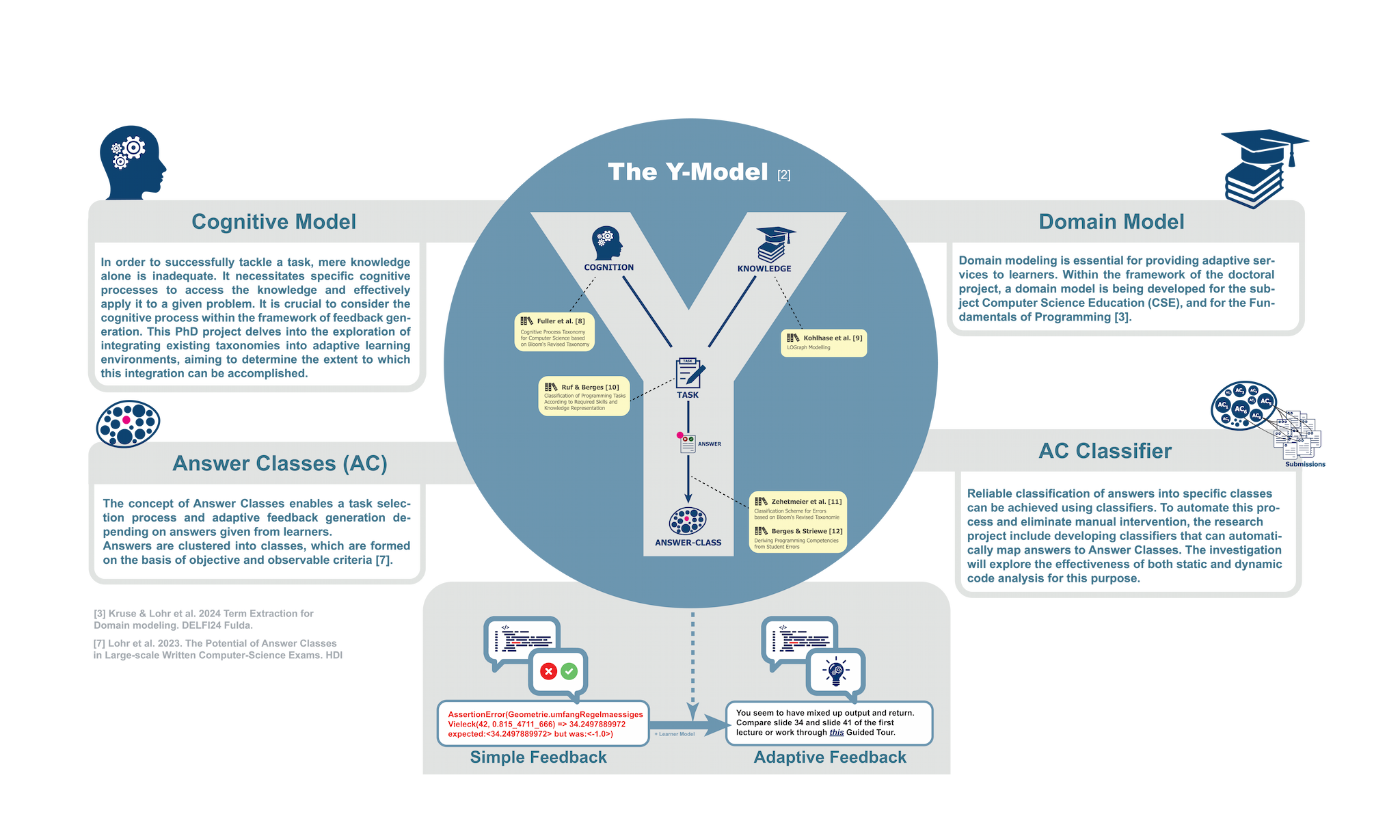
The Y-Model Framework
Lohr D., Berges M., Kohlhase M., Müller, D., Rapp, M.
The Y-Model - Formalization of Computer Science Tasks in the Context of Adaptive Learning Systems
IEEE 2nd German Education Conference (GECon23)
year: 2023
Using Large Language Models to generate formative Programming Feedback
Kiesler N., Lohr D., Keuning H.
Exploring the Potential of Large Language Models to Generate Formative Programming Feedback
2023 IEEE Frontiers in Education Conference (FIE)
year: 2023
Lohr D., Kiesler N., Keuning H.
You're (Not) My Type - Can LLMs Generate Feedback of Specific Types for Introductory Programming Tasks?
Journal of Computer Assisted Learning (JCAL)
year: 2025